SEO
Set the page title, meta description, noindex, hreflang alternates and sitemap entries of VitNode Content Engine record pages with delivery.seo and delivery.sitemap.
Once a content type has public pages, delivery.seo decides which fields fill each page's <title>, meta description and robots tag, and delivery.sitemap lists the pages for crawlers. You name fields; the Content Engine reads them from every published record, so editors never fill in a separate SEO form unless you give them one.
The examples use example.article from the example plugin and blog.post from the blog plugin, which is localized.
Pick the SEO fields
example.article uses its title and excerpt, plus a boolean that hides a record from search engines:
fields: {
  title: field.text({ required: true, minLength: 3, maxLength: 200 }),
  excerpt: field.textarea({ maxLength: 500, nullable: true }),
  noIndex: field.boolean({ nullable: true }),
},

publicApi: {
  path: "articles",
  fields: ["title", "slug", "excerpt", "noIndex", "publishedAt"],
},

delivery: {
  redirects: true,
  seo: {
    titleField: "title",
    descriptionField: "excerpt",
    noIndexField: "noIndex",
    openGraph: { titleField: "title", descriptionField: "excerpt" },
  },
  sitemap: { changeFrequency: "weekly", priority: 0.7 },
},| Option | Field kinds | Used for |
|---|---|---|
titleField | text | Page title |
fallbackTitleField | text | Page title when titleField is empty. Needs titleField |
descriptionField | text, textarea, richText | Meta description |
fallbackDescriptionField | text, textarea, richText | Description when descriptionField is empty |
noIndexField | boolean, not localized | robots tag and sitemap, see noindex |
openGraph.titleField | text | Open Graph title, falls back to the page title |
openGraph.descriptionField | text, textarea, richText | Open Graph description, falls back to the page description |
Every field you name must also be in publicApi.fields, because the page shows it to anyone. Leave one out and the definition throws at startup with ... which is not in publicApi.fields. A field inside a group works ("seo.title"). A field inside a repeatable does not, since a page has one title, not a list of them.
Values are trimmed, and an empty one counts as missing, so the fallback kicks in. The blog uses that to describe posts that have no excerpt:
delivery: {
  seo: {
    titleField: "title",
    descriptionField: "excerpt",
    fallbackDescriptionField: "content",
  },
},
content is rich text. The Content Engine turns it into plain text, and the page cuts it to 160 characters at a word boundary and adds …. No markup ever lands in a meta tag.
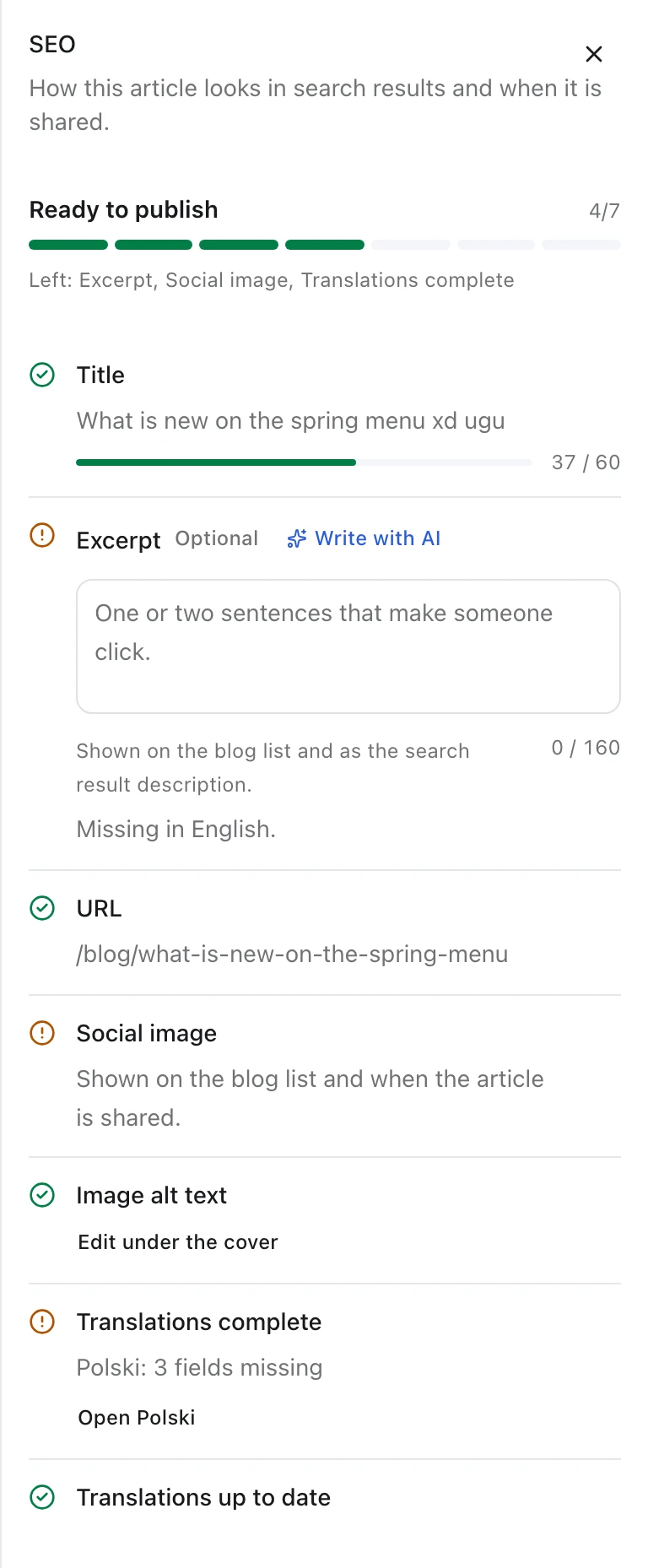
The blog plugin's own article editor checks the fields this rule reads in its SEO sheet. The sheet belongs to the blog plugin, not to every Content Engine form. Here the post has no excerpt, so the Excerpt row is marked as missing, and search results would fall back to the content.
What reaches the page head
The page's head calls contentDeliveryPageHead with the resolve route's answer, as shown in Write the page. This is what the HTML gets today:
| Tag | Rendered |
|---|---|
<title> | Yes, followed by the site title (- VitNode) |
<meta name="description"> | Yes, at most 160 characters |
<meta name="robots"> | Only for a no-index record |
<link rel="canonical"> and hreflang links | Only for a localized content type |
og:title, og:description | No |
The resolve route returns openGraph and canonicalPath for every record, but nothing turns them into tags yet. A nonlocalized type such as example.article gets no canonical link, and no content type gets Open Graph tags. A plugin page cannot add them either, because its head only accepts title, description, robots and alternates. Keep openGraph in your definition so the data is ready, and read it from the resolve route if you render pages outside VitNode.
Hide a record from search engines
noIndexField names one boolean that drives two things together:
- the page gets
<meta content="noindex, nofollow" name="robots"/>; - the record leaves the sitemap.
Only true hides a record. null and false both mean "index it", which is why example.article can make the field nullable without emptying its sitemap. The resolve route reports the decision as "robots": { "follow": true, "index": false }.
The field must be shared, not localized. A record has one indexing decision, and a per-language value would let the Polish page say noindex while the sitemap lists the English one. The definition refuses a localized noIndexField for that reason.
Localized alternates and hreflang
For a localized content type, the page head links every published translation of the record. The blog post english-title is published in English and Polish, so /blog/english-title gets:
<link href="http://localhost:3000/blog/english-title" rel="canonical"/>
<link href="http://localhost:3000/blog/english-title" hrefLang="en" rel="alternate"/>
<link href="http://localhost:3000/pl/wpisy/polish-title" hrefLang="pl" rel="alternate"/>
<link href="http://localhost:3000/blog/english-title" hrefLang="x-default" rel="alternate"/>- The canonical link is the page's own language.
- Each URL follows the app's localized URL rules, which is how the Polish post ends up at
/pl/wpisy/.... - Links are absolute, built from
VITNODE_WEB_URL(http://localhost:3000when unset) unless a language has its own domain. - A translation that is not published is not an alternate.
- Delivery on a localized type needs
"id"inpublicApi.fields, because alternates are looked up by record id. The definition throws without it.
hreflang: { xDefault: "defaultLocale" } adds hreflang.xDefault to the resolve route's answer, pointing at the record's default-language URL when that translation is published. It needs localization. The page head does not read this option. It adds its x-default link whenever the app's default language is among the alternates, with or without it, so the option only matters when you read the resolve route yourself.
delivery: {
  hreflang: { xDefault: "defaultLocale" },
},
Sitemap
delivery.sitemap adds a public route that lists every published URL of the content type, oldest record first. Pass true or { changeFrequency, priority }. It needs publication: true, since a sitemap lists only what readers can reach.
curl "http://localhost:3000/api/@vitnode/example/content/articles/delivery/sitemap?cursor=1&limit=1"{
"entries": [
{
"changeFrequency": "weekly",
"itemId": 3,
"lastModified": "2026-10-10T11:06:30.518Z",
"locale": null,
"path": "/articles/hello-content-engine",
"priority": 0.7
}
],
"nextCursor": null
}- A page holds 1,000 entries by default and up to 50,000 with
?limit=.cursoris theitemIdto continue after, so passnextCursorback as?cursor=until it isnull. lastModifiedis the record'supdatedAt, or the translation's when that is newer.- Records whose
noIndexFieldistrueare left out. - A localized type returns one language per request. Ask for another with
?locale=:
curl "http://localhost:3000/api/@vitnode/blog/content/blog/delivery/sitemap?locale=pl&limit=1"{
"entries": [
{
"changeFrequency": "weekly",
"itemId": 4,
"lastModified": "2026-08-12T18:00:43.308Z",
"locale": "pl",
"path": "/pl/wpisy/polish-title",
"priority": 0.7
}
],
"nextCursor": 4
}The app's /sitemap.xml does not read these routes for you, so add the entries where you build it. contentSitemapXml from @vitnode/core/content writes the XML:
import {
  contentSitemapXml,
  isContentSitemapChangeFrequency,
} from "@vitnode/core/content";

const response = await fetch(
  "http://localhost:3000/api/@vitnode/example/content/articles/delivery/sitemap",
);
const { entries } = await response.json();

const xml = contentSitemapXml({
  origin: "https://example.com",
  entries: entries.map(entry => ({
    ...entry,
    changeFrequency: isContentSitemapChangeFrequency(entry.changeFrequency)
      ? entry.changeFrequency
      : null,
    lastModified: new Date(entry.lastModified),
  })),
});
With the example plugin's two published articles, xml is:
<?xml version="1.0" encoding="UTF-8"?>
<urlset xmlns="http://www.sitemaps.org/schemas/sitemap/0.9">
  <url>
    <loc>https://example.com/articles/jbbjk-1</loc>
    <lastmod>2026-08-30T09:18:25.398Z</lastmod>
    <changefreq>weekly</changefreq>
    <priority>0.7</priority>
  </url>
  <url>
    <loc>https://example.com/articles/hello-content-engine</loc>
    <lastmod>2026-10-10T11:06:30.518Z</lastmod>
    <changefreq>weekly</changefreq>
    <priority>0.7</priority>
  </url>
</urlset>
contentSitemapIndexXml writes a <sitemapindex> once one file is not enough, for example one file per content type and language.
Retired slugs
With delivery.redirects, an old slug answers a permanent 308 redirect to the record's current URL, so links and search results that still use the old address land on the new page. See Keep old URLs working.
Check the result
Print the SEO tags of an article and of a localized blog post:
curl -s http://localhost:3000/articles/hello-content-engine | grep -oE '<title>[^<]*</title>|<meta [^>]*name="(description|robots)"[^>]*>|<link [^>]*rel="(canonical|alternate)"[^>]*>'<title>Hello Content Engine - VitNode</title>
<meta content="A first article from the example plugin, served by the public API and rendered on its own page." name="description"/>Run the same command for http://localhost:3000/blog/english-title and you get its title, description and the four links from Localized alternates. The SVG logo's <title>Logo VitNode</title> may show up too; it is not page metadata.
Then ask the resolve route what the page was given, openGraph and robots included:
curl http://localhost:3000/api/@vitnode/example/content/articles/delivery/resolve/hello-content-engineSet noIndex on a test article, publish it, and run both commands again. The page gains the robots tag, and the sitemap route stops listing it.