Search
Add a Content Engine content type to the VitNode site search, keep the search index in sync with published records, and rebuild it from the AdminCP.
Add a search block to a content type and its published records show up on the site search page at /search. VitNode writes a search document after every save, publish and delete, so you never call the search engine yourself. This guide turns search on for example.article from the example plugin.
Before you begin
The content type needs publication and a public API, because a search result is a link to a public page and its text has to be public already. Without them, the definition throws when it loads: search needs `publication: true`. or search needs `publicApi: { path, fields }`.
It also needs a page that serves the result URL. Public pages shows how to add one.
Add the search block
Add search to the definition. This excerpt leaves out the fields and blocks search does not read:
export const articleContentType = defineContentType({
  id: "example.article",
  tableName: "example_articles",
  fields: {
    title: field.text({ required: true, minLength: 3, maxLength: 200 }),
    slug: field.slug({ source: "title" }),
    excerpt: field.textarea({ maxLength: 500, nullable: true }),
    author: field.user(),
  },
  publication: true,
  publicApi: {
    path: "articles",
    fields: ["title", "slug", "excerpt", "publishedAt"],
  },
  search: {
    titleField: "title",
    descriptionField: "excerpt",
    contentFields: ["title", "excerpt"],
    pathTemplate: "/articles/{slug}",
    authorField: "author",
  },
});titleFieldis the result heading. It must be afield.text()that is not nullable.descriptionFieldis optional and leads the result excerpt. Text, textarea or rich text.contentFieldsis the searchable body. It takes at least one field and no duplicates. Text, textarea, rich text or slug fields, plus repeatable leaves such as"faq.answer". Rich text is indexed as its words, never as JSON. The title always ranks higher than the body, so listing it here as well only repeats it in the excerpt.pathTemplateis the result URL. It starts with/and contains{slug}exactly once. Leave the language out, because your i18n settings add it (see Localized content types).authorFieldis optional and credits a top-levelfield.user()on member timelines.
Every field except authorField must be in publicApi.fields. Otherwise a result snippet would leak a private value, so the definition throws instead: search.titleField names "x", which is not in publicApi.fields. authorField may stay private, which is why author is not in the public list above. All options are in the reference.
Index the records you already have
New writes are indexed from now on, but records saved before the search block existed are not. Open AdminCP → Advanced → Search (/admin/core/advanced/search), type example.article into Search collections…, and click Reindex on that row. Rebuild index at the top rebuilds every collection.
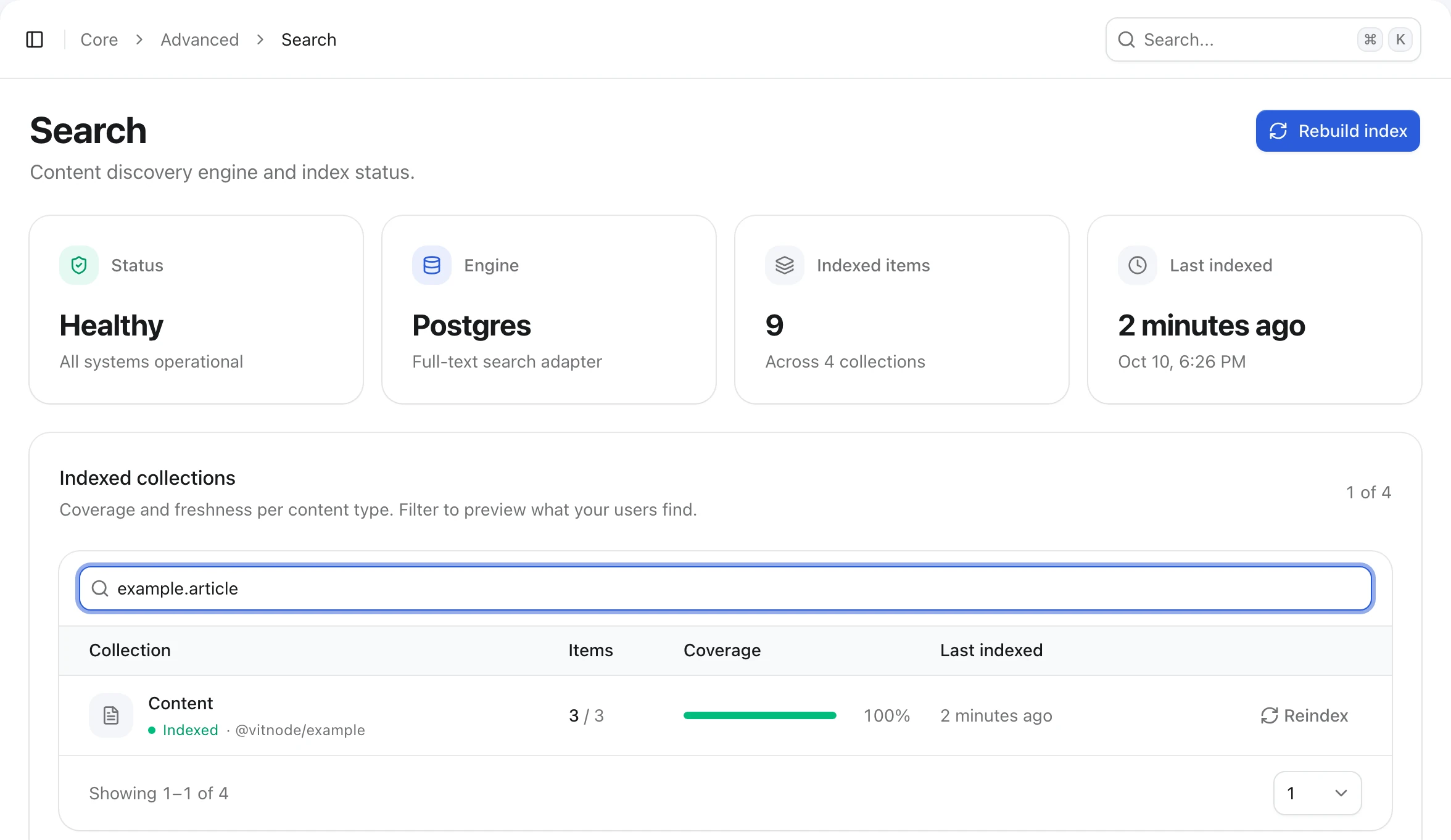
Both buttons need the Rebuild and clear the search index staff permission (system → can_manage_search). A rebuild clears the collection and refills it in pages of 200 records. It is a queued job, so it only runs while cron is running.
Items compares indexed documents with records in the table, drafts included. Content Engine collections are all labelled Content for now, so filter by the content type id to find yours.
What gets indexed and when
Every record is in the index, but only public ones show up on /search. A draft is stored as a private document without a URL. With authorField, it appears on its author's own timeline and on the AdminCP user page, but never in public results.
| Write | Search index |
|---|---|
| Create, edit, publish, unpublish, restore or delete in the AdminCP | Updated right after the write |
| A scheduled publish or unpublish | Updated when the job runs |
Your own route using the editorial service and contentEditorialEffects | Updated |
The plain service from model.service(c) | Not updated |
An edit rewrites the document only when an indexed field changed: the title, description, content fields, slug or author. Unpublishing keeps the document but makes it private, so the record drops out of /search at once. Deleting the record removes its document.
The plain service writes rows and nothing else. To change records from your own code and keep search in sync, follow a "Feature this article" button.
If the search engine fails, the save still succeeds. The failure is logged with a [content-search] prefix and listed under Recent sync failures on the AdminCP Search screen. Reindex the collection to repair it.
Localized content types
A localized content type such as example.localized-article gets one document per translation, with the language stored on it. A translation is public only when both the record and that translation are published. Deleting a translation removes only that language's document. Deleting the record removes all of them.
/search shows documents in the visitor's language. Documents of content types that are not localized match every language. With localization.fallback: "default", a visitor whose language has no published translation sees the default language's document instead.
Each document gets the URL of its own language. pathTemplate stays the English route, and VitNode adds the prefix, domain and translated segments from your localized URL settings. The table in Result URLs for Content Engine types shows what each setting produces. URLs are stored at indexing time, so reindex after changing pathTemplate or those settings.
Check the result
- Publish an article in AdminCP → Example → Articles.
- Open
/searchand type a whole word or two from its title or excerpt. The result links to/articles/{slug}.
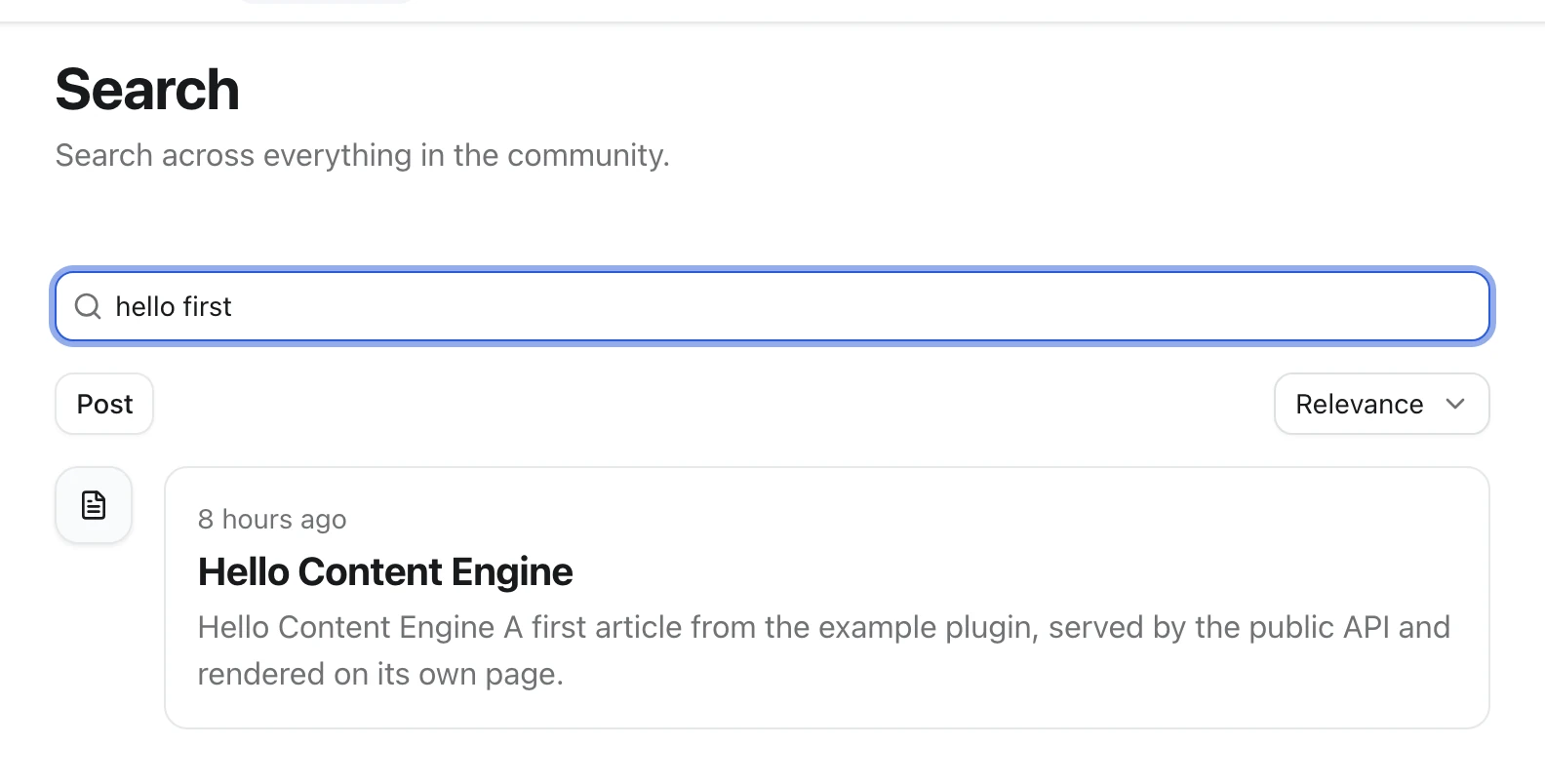
The same results come from the public search API. types limits them to one content type:
curl "http://localhost:3000/api/@vitnode/core/search?search=hello&types=example.article"{
"edges": [
{
"pluginId": "@vitnode/example",
"itemType": "example.article",
"itemId": 3,
"languageCode": "",
"title": "Hello Content Engine",
"content": "Hello Content Engine A first article from the example plugin, served by the public API and rendered on its own page.",
"url": "/articles/hello-content-engine",
"isPublic": true
}
]
}Unpublish the article and run the request again. This time edges is empty. If a record you published before adding search is missing, reindex the collection.
The index runs on Postgres full-text search by default. To switch engines, or to index data that is not a content type, see Search & Discovery and Elasticsearch.