Fields
Reference for every Content Engine field helper, such as field.text, field.relation and field.blocks, with its options, defaults, Postgres column and AdminCP form control.
A field is one property of a content type, such as a title or a view count. You build each one with a helper from field, exported by @vitnode/core/content. The helper decides three things at once: the Postgres column, the validation of every write and the control in the AdminCP form.
import { defineContentType, field } from "@vitnode/core/content";

export const articleContentType = defineContentType({
  id: "example.article",
  tableName: "example_articles",
  fields: {
    title: field.text({ required: true, minLength: 3, maxLength: 200 }),
    slug: field.slug({ source: "title" }),
    views: field.number({ integer: true, min: 0, defaultValue: 0 }),
    featured: field.boolean({ defaultValue: false }),
    author: field.user(),
  },
});
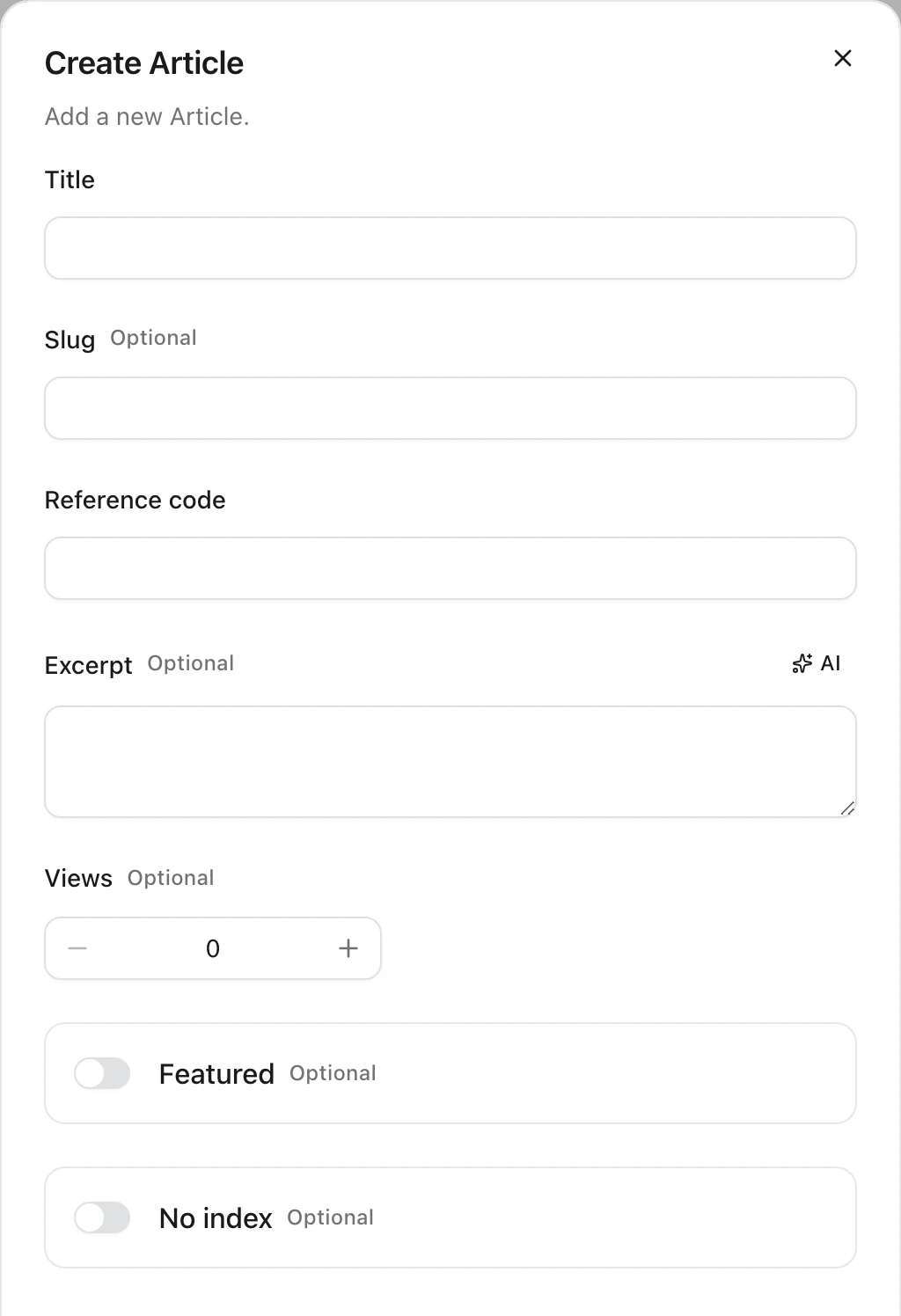
The example plugin's article form shows most controls. The first half holds the plain values:
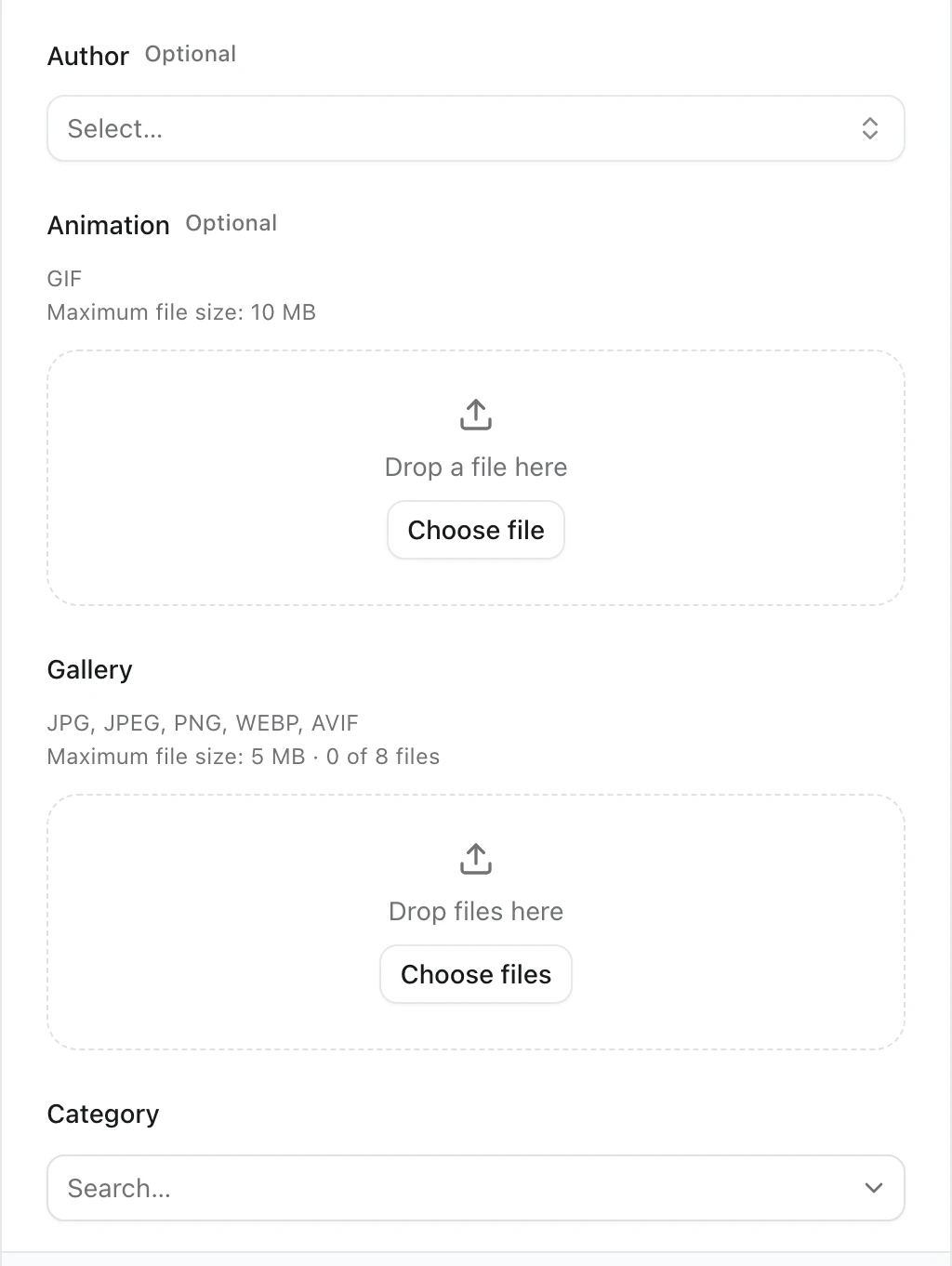
The second half holds the references: a user picker, two file dropzones and a relation picker.
Field helpers
| Helper | Postgres column | AdminCP control | Can be localized |
|---|---|---|---|
field.text() | varchar(maxLength), 255 by default | Text input | Yes |
field.textarea() | text | Textarea | Yes |
field.richText() | jsonb | Rich text editor | Yes |
field.number() | integer or double precision | Number input with steppers | No |
field.boolean() | boolean | Switch | No |
field.enum() | varchar(length), 64 by default | Select or radio buttons | No |
field.dateTime() | timestamp | Date and time picker | No |
field.slug() | varchar(maxLength), 160 by default, unique | Text input | Yes |
field.user() | integer referencing core_users.id | User picker | No |
field.file() | integer referencing core_files.id | File dropzone | No |
field.relation() | integer referencing the target table | Search picker | No |
field.group() | One column per leaf | A fieldset with the leaf controls | Yes, as a whole |
field.repeatable() | A child table | A list of rows you can add, move, remove | No |
field.blocks() | jsonb, NOT NULL DEFAULT '[]' | Not in the form; edited as widgets | Yes |
user, file and relation with multiple: true store their values in a junction table instead of a column. Localized fields live in the translation table. See Translations.
Shared options
Every helper except slug, repeatable and blocks accepts these:
| Name | Type | Required | Default | Description |
|---|---|---|---|---|
required | boolean | No | false | A create request must include the field |
nullable | boolean | No | false | The column accepts NULL, and so does validation |
description | string | No | Text or an i18n key shown under the control in the AdminCP |
A field that is neither required nor nullable needs a fallback, or defineContentType throws Field "x" is neither required nor nullable, so it needs a default value. A defaultValue, defaultNow: true on a date and source on a slug all count as a fallback. On update every field is optional.
required: true on a text field still accepts an empty string. Add minLength: 1 when you need actual text.
Text and textarea
code: field.text({ required: true, maxLength: 100, unique: true }),
excerpt: field.textarea({ maxLength: 500, nullable: true }),| Name | Type | Required | Default | Description |
|---|---|---|---|---|
minLength | number | No | Shortest accepted value, in characters | |
maxLength | number | No | 255 column on text | Longest accepted value. On text it is also the varchar length |
defaultValue | string | No | Written when a create leaves the field out. Becomes the column DEFAULT | |
unique | boolean | No | false | text only. Adds a unique index. Has no effect on a localized field |
localized | boolean | No | false | One value per language |
ai | object | No | Adds an AI suggestion button, see AI suggestions |
Set maxLength on every text field. Without it, validation accepts any length, and Postgres rejects anything over 255 characters with a database error instead of a validation message. A defaultValue must satisfy the field's own minLength and maxLength.
Rich text
content: field.richText({ localized: true, required: true }),| Name | Type | Required | Default | Description |
|---|---|---|---|---|
maxBytes | number | No | 1 MB | Largest document, measured as UTF-8 JSON. At most 16 MB |
localized | boolean | No | false | One document per language |
The value is a ProseMirror JSON document. A rich text field has no defaultValue, so set required or nullable. With required: true a document without any text or media is refused. Documents nested deeper than 64 levels are refused too. Rich text covers rendering and the plain text and HTML helpers.
Number
views: field.number({ integer: true, min: 0, defaultValue: 0 }),| Name | Type | Required | Default | Description |
|---|---|---|---|---|
integer | boolean | Yes | true makes an integer column, false a double precision one | |
min, max | number | No | Accepted range. With integer: true a whole number must fit between them | |
defaultValue | number | No | Must sit inside the range, and be whole when integer: true |
Boolean
featured: field.boolean({ defaultValue: false }),The only option besides the shared ones is defaultValue. A nullable boolean, such as noIndex: field.boolean({ nullable: true }), can hold true, false or null.
Enum
difficulty: field.enum({ values: ["easy", "medium", "hard"], defaultValue: "easy", display: "radio" }),| Name | Type | Required | Default | Description |
|---|---|---|---|---|
values | string[] | Yes | Non-empty, without duplicates | |
defaultValue | one of values | No | ||
display | "select" | "radio" | No | "select" | AdminCP control |
length | number | No | 64 | varchar length. Every value must fit |
The column is a plain varchar, not a Postgres enum, so adding a value later needs no type migration. The AdminCP translates each value from {pluginId}.content.{entity}.enums.{field}.{value} when that key exists.
Date and time
eventDate: field.dateTime({ defaultNow: true }),| Name | Type | Required | Default | Description |
|---|---|---|---|---|
defaultNow | boolean | No | false | Fills the column with the current time on insert |
There is no defaultValue. Send dates as ISO 8601 strings.
Slug
slug: field.slug({ source: "title" }),| Name | Type | Required | Default | Description |
|---|---|---|---|---|
source | name of a text field | No | Fills the slug from that field when a create sends no slug | |
maxLength | number | No | 160 | varchar length and the point where long slugs are cut |
localized | boolean | No | false | One slug per language |
description | string | No | Shown under the input |
A slug has no required or nullable option. It is required when there is no source, and it is never empty. Every value is normalized, so "Weekend Pancakes!" becomes weekend-pancakes. Slugs are unique across the table, or within each language when localized. The slug is derived only on create, so renaming the title later keeps the old URL. source must name a field.text(), and a localized slug needs a localized source.
User
author: field.user(),
authorId: field.user({ multiple: true, ordered: true, min: 1 }),| Name | Type | Required | Default | Description |
|---|---|---|---|---|
multiple | boolean | No | false | Several people, stored in a junction table |
ordered | boolean | No | false | Keeps the order editors arrange |
min | number | No | Fewest people. Needs multiple | |
onDelete | "cascade" | "restrict" | "set null" | No | see below | What deleting the user does |
A single user field is nullable unless you set required: true. onDelete defaults to "set null" for a nullable single user, "restrict" for a required one and "cascade" for multiple. User fields cannot be listed in publicApi.fields.
File
animation: field.file({
  maxBytes: 10 * 1024 * 1024,
  allowedExtensions: [".gif"],
  allowedMimeTypes: ["image/gif"],
}),
gallery: field.file({ multiple: true, min: 1, max: 8, maxBytes: 5 * 1024 * 1024 }),| Name | Type | Required | Default | Description |
|---|---|---|---|---|
maxBytes | number | Yes | Largest accepted file, in bytes | |
allowedExtensions | string[] | No | any | Lowercased, with a leading dot added |
allowedMimeTypes | string[] | No | any | Lowercased |
multiple | boolean | No | false | Several files in a junction table |
min | number | No | Fewest files, at least 1. Needs multiple | |
max | number | No | 20 | Most files, up to 200. Needs multiple |
ordered | boolean | No | same as multiple | Keeps the order editors arrange |
A single file field is nullable unless you set required: true, and it cannot have a default or be localized. Translate a caption or alt text in a separate localized text field instead. Uploads go through the storage adapter and land in core_files. A file in use cannot be deleted, because the reference is ON DELETE RESTRICT.
The public API returns a file as { id, name, url, mimeType, size, width, height }, never as a raw id. A write may only point at a file uploaded for this content type, uploaded by the signed-in user, or already on the record. The API refuses anything else with CONTENT_FILE_NOT_FOUND.
Relation
category: field.relation({ required: true, onDelete: "restrict", target: () => categoryContentType }),| Name | Type | Required | Default | Description |
|---|---|---|---|---|
target | () => ContentTypeDefinition | Yes, unless self | The linked content type | |
self | true | No | false | Links to the same content type. Do not combine with target |
multiple | boolean | No | false | Uses a junction table, up to 500 targets per record |
ordered | boolean | No | false | Keeps the editor's order. Needs multiple |
min | number | No | Fewest targets, 1 to 500. Needs multiple | |
onDelete | "restrict" | "cascade" | "set null" | No | "restrict" | What deleting the target does. "set null" needs a nullable single relation |
A single relation must be required or nullable. A to-many relation can be neither. Relations shows the model wiring and the junction tables.
Group
syndication: field.group({
  fields: {
    noIndex: field.boolean({ defaultValue: false }),
    priority: field.number({ integer: true, min: 0, max: 10, defaultValue: 5 }),
  },
}),| Name | Type | Required | Default | Description |
|---|---|---|---|---|
fields | object of leaf fields | Yes | text, textarea, number, boolean, enum or dateTime leaves | |
localized | boolean | No | false | Moves every leaf to the translation table together |
Each leaf becomes a column named <group><Leaf>, such as syndicationPriority. Leaves cannot set localized themselves. An optional group needs leaves that are nullable or have a default. A nullable group needs nullable leaves.
Repeatable
faq: field.repeatable({
  max: 20,
  fields: {
    question: field.text({ required: true, minLength: 3, maxLength: 200 }),
    answer: field.textarea({ required: true }),
  },
}),| Name | Type | Required | Default | Description |
|---|---|---|---|---|
fields | object of leaf fields | Yes | Same leaf kinds as a group | |
min | number | No | 0 | Fewest rows |
max | number | No | 100 | Most rows, up to 1000 |
description | string | No | Shown in the AdminCP form |
Rows live in a child table. A repeatable is always shared between languages.
Blocks
content: field.blocks({ allowed: ["core:*", "example:callout", "example:features"], max: 50 }),| Name | Type | Required | Default | Description |
|---|---|---|---|---|
allowed | "*" or string[] | No | "*" | Which blocks may be placed, such as "core:*" |
min | number | No | Fewest block instances | |
max | number | No | 200 | Most block instances, up to 1000 |
localized | boolean | No | false | Each language gets its own blocks |
description | string | No |
field.widgets() is the same helper under another name. A blocks field is never required or nullable. No blocks means an empty list. It does not appear in the AdminCP form. Editors place widgets on the page itself, as described in The blocks() field.
AI suggestions
text and textarea fields accept an ai option. The form then shows an AI button next to the label, like the excerpt in the screenshot above.
excerpt: field.textarea({
  ai: {
    action: "@vitnode/example:article.excerpt",
    mode: "suggestion",
    sourceFields: ["title", "code"],
  },
  maxLength: 500,
  nullable: true,
}),| Name | Type | Required | Default | Description |
|---|---|---|---|---|
action | "<pluginId>:<actionId>" | Yes | A registered AI action | |
mode | "suggestion" | Yes | The only supported mode. The editor reviews the text before it is used | |
sourceFields | string[] | Yes | Other fields of this content type sent to the action as input |
AI in fields and the editor shows how to write the action.
Searching and sorting
Fields have no searchable or sortable option. Each surface picks its own fields: admin.list.searchableFields and orderableFields for the AdminCP list, publicApi.searchableFields, orderableFields and filterableFields for the public API, and search.contentFields for site search. The content type reference lists which field kinds each one accepts.