Relations
Link Content Engine records with field.relation, group related fields with field.group and store repeatable rows with field.repeatable, all in real Postgres tables.
Relations connect one record to others, and two related helpers shape a record's own data. Everything lands in real tables, not a JSON blob: a relation is a foreign key, a to-many relation is a junction table, a group is a set of columns and a repeatable field is a child table. This guide walks through example.advanced-article from the example plugin, which uses all four.
Before you begin
You need a working content type to link to, such as example.category from Create a content type.
Link to one record
Point an article at a category with field.relation. target is a function, so two content types can refer to each other without an import cycle:
import { categoryContentType } from "./category";

fields: {
  category: field.relation({
    required: true,
    onDelete: "restrict",
    target: () => categoryContentType,
  }),
},
Then tell createContentModel which column the foreign key references:
import { example_categories } from "./categories";

export const articleContent = createContentModel(articleContentType, {
  references: { category: () => example_categories.id },
});
references needs one entry per relation field. A missing or extra key is a type error. field.user(), field.file() and self: true relations find their table on their own and need no entry.
Link to many records
Add multiple: true. The advanced article has two to-many relations: a set of categories and an ordered "read next" list that points back at articles:
fields: {
  categories: field.relation({
    multiple: true,
    onDelete: "restrict",
    target: () => categoryContentType,
  }),
  relatedArticles: field.relation({
    multiple: true,
    onDelete: "cascade",
    ordered: true,
    self: true,
  }),
},
ordered: true keeps the order editors arrange. Without it, the set is stored in ascending id order. onDelete: "cascade" on a to-many relation drops the link when the target is deleted, and "restrict" refuses the delete. A to-many relation cannot be required or nullable; use min: 1 to demand at least one target.
Each to-many field gets a junction table with itemId, relatedItemId, position and createdAt. Give categories its reference and export both junction tables, or Drizzle Kit leaves them out of the migration:
export const advancedArticleContent = createContentModel(
  advancedArticleContentType,
  { references: { categories: () => example_categories.id } },
);

export const example_advanced_articles = advancedArticleContent.table;
export const example_advanced_articles_categories =
  advancedArticleContent.advancedTables.junctions.categories;
export const example_advanced_articles_related_articles =
  advancedArticleContent.advancedTables.junctions.relatedArticles;
Group related fields
field.group keeps fields that belong together under one key:
syndication: field.group({
  fields: {
    indexable: field.boolean({ defaultValue: true }),
    noIndex: field.boolean({ defaultValue: false }),
    priority: field.number({ integer: true, min: 0, max: 10, defaultValue: 5 }),
  },
}),
A group adds one column per leaf to the main table: syndicationIndexable, syndicationNoIndex and syndicationPriority. The API reads and writes it as { syndication: { indexable, noIndex, priority } }, and other options refer to a leaf by path, such as indexes: [{ on: ["syndication.priority"] }]. Leaves can be text, textarea, number, boolean, enum or dateTime fields. An optional group needs leaves that are nullable or have a default.
Add repeatable rows
field.repeatable stores an ordered list of small rows, such as FAQ entries:
faq: field.repeatable({
  max: 20,
  fields: {
    question: field.text({ required: true, minLength: 3, maxLength: 200 }),
    answer: field.textarea({ required: true }),
  },
}),
The rows go to a child table, example_advanced_articles_faq, with id, itemId, position, createdAt, updatedAt and one column per leaf. Deleting the article deletes its rows. Export the child table too:
export const example_advanced_articles_faq =
  advancedArticleContent.advancedTables.repeatables.faq;
Build and migrate
bun run build:plugins && bun run db:migrateThe generated migration creates one table per junction and repeatable field.
Write related values
A relation takes ids. A to-many relation and a repeatable take the whole list, which replaces what the record had:
{
  "categories": [2, 4],
  "syndication": { "priority": 7 },
  "faq": [
    {
      "id": 1,
      "question": "Can I freeze the batter?",
      "answer": "Yes, for up to a month."
    },
    { "question": "Do I need buttermilk?", "answer": "No, regular milk works." }
  ]
}
A repeatable row with an id updates that row, a row without one is created, and rows you leave out are deleted. The API refuses an id that belongs to another record with CONTENT_REPEATABLE_UNKNOWN_CHILD. To change one link or one row without sending the list, use the content service: relations.categories.add(), .remove(), .set(), .reorder() and .get(), or repeatable.faq.create(), .update(), .delete(), .reorder(), .set() and .list().
Check the result
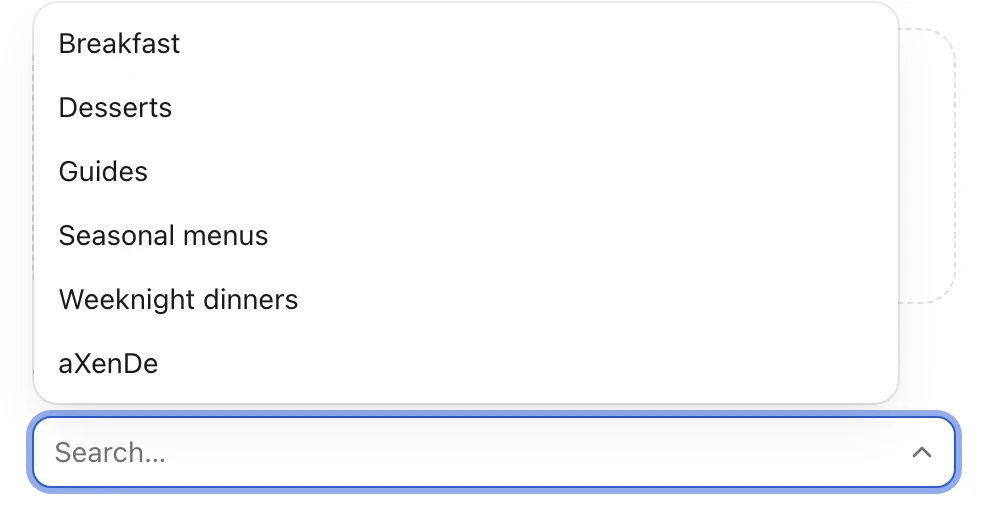
In the AdminCP form, a single relation is a search picker. This is the article's Category field:
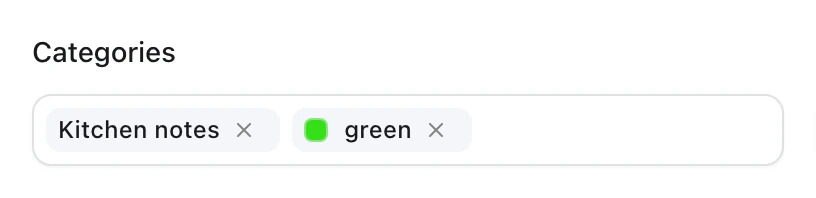
A to-many relation shows each target as a chip you can remove. Here is the blog plugin's Categories field, a field.relation({ multiple: true }):
A group renders as a fieldset with its leaf controls, and a repeatable as a list of rows with move up, move down and remove buttons plus an Add button. The example plugin gives the advanced article API routes but no AdminCP screen, so test it through the API. Its public API returns the related values like this:
curl "http://localhost:3000/api/@vitnode/example/content/advanced-articles/weekend-pancakes?locale=en"{
"id": 1,
"title": "Weekend pancakes",
"slug": "weekend-pancakes",
"categories": [2, 4],
"seo": {
"title": "Fluffy weekend pancakes",
"description": "Ready in 20 minutes."
},
"syndication": { "priority": 7, "noIndex": false },
"faq": [
{
"id": 1,
"question": "Can I freeze the batter?",
"answer": "Yes, for up to a month."
},
{
"id": 2,
"question": "Do I need buttermilk?",
"answer": "No, regular milk works."
}
],
"publishedAt": "2026-10-10T10:57:42.767Z",
"locale": "en"
}A to-many relation comes back as a list of ids, and a single relation as { "id": 2 }. Only the leaves listed in publicApi.fields, such as "faq.question", are public. The example plugin's page at /advanced-articles/weekend-pancakes renders the FAQ rows:

Every option of these helpers is in the Fields reference.