Public API
Add drafts and publishing to a VitNode Content Engine content type, expose published records through typed read-only public API routes, and read them with the fetcher.
A content type is private until you opt in. This guide follows example.article from the example plugin. It gets a draft and a published state, and its published records become readable by anyone at /api/@vitnode/example/content/articles. You list exactly which fields leave the server.
You need a content type with an AdminCP screen, like the one built in Create a content type.
Turn on publication and the public API
Add publication and publicApi to the definition. This excerpt leaves out the article fields this guide does not use:
export const articleContentType = defineContentType({
  id: "example.article",
  tableName: "example_articles",
  fields: {
    title: field.text({ required: true, minLength: 3, maxLength: 200 }),
    slug: field.slug({ source: "title" }),
    excerpt: field.textarea({ maxLength: 500, nullable: true }),
    featured: field.boolean({ defaultValue: false }),
    author: field.user(),
    category: field.relation({
      required: true,
      onDelete: "restrict",
      target: () => categoryContentType,
    }),
  },
  publication: true,
  publicApi: {
    path: "articles",
    fields: ["title", "slug", "excerpt", "featured", "category", "publishedAt"],
    searchableFields: ["title", "excerpt"],
    orderableFields: ["publishedAt", "title"],
    filterableFields: ["category", "featured"],
    defaultOrderBy: "publishedAt",
    defaultOrder: "desc",
  },
});publicationadds astatuscolumn (draftorpublished, defaultdraft), apublishedAttimestamp, acan_publishstaff permission and Publish / Unpublish actions in the AdminCP.publicApi.fieldsis an allowlist with no wildcard. It needs exactly one slug field, because the detail route finds records by slug.statusandfield.user()fields can never be listed, which is whyauthorstays private.- Searchable, filterable and orderable fields must also be in
fields.publishedAtis always orderable and is the default sort. pathis one lowercase URL segment and cannot beadmin.
publicApi without publication throws when the definition loads, so drafts cannot leak by accident.
Register the public module
Add buildContentPublicModule to the plugin's API config. The example plugin passes all five content models; one without publicApi is skipped:
import { buildContentPublicModule } from "@vitnode/core/content/server";

import { articleContent } from "@/database/articles";

export const exampleApiPlugin = () =>
  buildApiPlugin({
    pluginId: CONFIG_PLUGIN.pluginId,
    modules: [
      adminModule,
      buildContentPublicModule({
        pluginId: CONFIG_PLUGIN.pluginId,
        contentTypes: [articleContent],
      }),
    ],
  });
Label the publish permission
Give the new permission a name next to the other article permissions. The Status and Published at columns need no strings, because the AdminCP derives them from the column names.
{
  "@vitnode/example:article:can_publish": "Publish and unpublish articles"
}
Build, migrate and restart
Run this from the workspace root, then restart pnpm dev so the API registers the new routes:
bun run build:plugins && bun run db:migrateThe migration adds status, publishedAt and an example_articles_status_published_at_idx index. Existing rows become drafts. Database covers migrations in detail.
Publish an article
Open AdminCP → Example → Articles. New articles show a Draft badge. Click the paper plane Publish button at the end of a row:
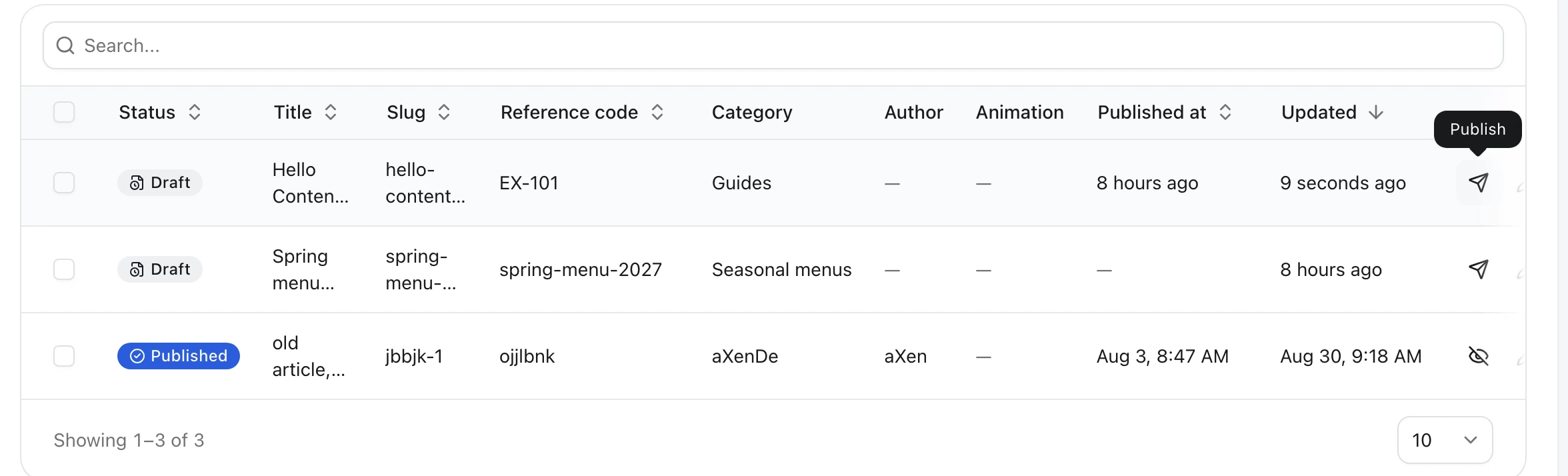
Confirm with Yes, publish it. The badge turns into Published and the article appears in the public API.

The Create Article dialog also gets Save as draft and Publish buttons, and you can publish many rows at once with bulk actions.
Check the result
Request the list. Filters are query parameters named after the field, and orderBy accepts the orderable fields:
curl "http://localhost:3000/api/@vitnode/example/content/articles?featured=false&orderBy=title&order=asc&first=1"{
"edges": [
{
"title": "Hello Content Engine",
"slug": "hello-content-engine",
"excerpt": "A first article from the example plugin, served by the public API and rendered on its own page.",
"featured": false,
"category": { "id": 5 },
"publishedAt": "2026-10-10T10:55:34.335Z"
}
],
"pageInfo": {
"totalCount": 1,
"totalPages": 1,
"currentPage": null,
"pageSize": 1,
"count": 1,
"hasNextPage": false,
"hasPreviousPage": false,
"startCursor": "eyJjb2x1bW4iOiJ0aXRsZSIsImlkIjozLCJ2YWx1ZSI6IkhlbGxvIENvbnRlbnQgRW5naW5lIn0",
"endCursor": "eyJjb2x1bW4iOiJ0aXRsZSIsImlkIjozLCJ2YWx1ZSI6IkhlbGxvIENvbnRlbnQgRW5naW5lIn0"
}
}A relation comes back as { "id": 5 }. A file field, such as the example's gallery, comes back as { id, name, url, mimeType, size, width, height }, never as the raw file ID.
Unpublish the article and request it by slug. A draft, a record scheduled for later and a slug that never existed all get the same 404, so the API never confirms that a draft exists:
curl -i http://localhost:3000/api/@vitnode/example/content/articles/hello-content-engineHTTP/1.1 404
Article not found.Read the API from your plugin
The fetcher types the routes from the plugin's API registry. The module is content/ followed by publicApi.path. Put a helper like this anywhere in your plugin:
import { fetcher } from "@vitnode/core/tanstack/fetcher";
import { z } from "zod";

const zodArticleCard = z.object({
  excerpt: z.string().nullable(),
  publishedAt: z.string().nullable(),
  slug: z.string(),
  title: z.string(),
});

export const fetchFeaturedArticles = async () => {
  const response = await fetcher({
    plugin: "@vitnode/example",
    method: "get",
    module: "content/articles",
    path: "/",
    args: { query: { featured: true, first: 5 } },
  });

  if (response.status !== 200) {
    throw new Error(`Loading articles answered ${response.status}.`);
  }

  const { edges } = await response.json();

  return z.array(zodArticleCard).parse(edges);
};
The path, the query and pageInfo are typed. Each record is a Record<string, unknown>, so parse the fields you use with Zod, as the example's article page does. A content type without publicApi adds no module: module: "content/categories" is a compile error. An orderBy outside the allowlist type-checks but answers 400.
Public API routes
All routes are GET and live under /api/{pluginId}/content/{publicApi.path}.
| Route | Returns |
|---|---|
/ | Published records with edges and pageInfo |
/{slug} | One published record, or 404 |
/preview/{token} | A draft behind a signed link, only with preview links |
/delivery/resolve/{slug} | Whether a URL is a record, a redirect or nothing, only with delivery |
/delivery/item/{id} | Canonical URL and SEO metadata for one record, only with delivery |
/delivery/sitemap | Sitemap entries, only with delivery.sitemap |
The list accepts first or last (at most 50, also the default), cursor, page, search over searchableFields, orderBy, order and one parameter per filterable field. A record is public only when its status is published and its publishedAt is set and not later than the database clock. Every publicApi option is in the content type reference.
Next, give each article a web page with Public pages, or see how these reads are cached in Caching.