Moderation
Enable reports
Let signed-in readers report a VitNode Content Engine content type, such as blog articles, with one option and a Report button.
Turn on reports for a content type so signed-in readers can flag a published record to your moderators. This guide follows the blog plugin, whose articles are reportable.
Before you begin
The content type needs a public API. A reader can only report what the public API lets them read, so a draft, a hidden record or an unpublished translation can never be reported.
Turn on reports
Add reports: true to the content type definition:
export const blogPostContentType = defineContentType({
  id: "blog.post",
  tableName: "blog_posts",
  publication: true,
  visibility: true,
  reports: true,
  // ...
});
reports needs no migration. Reports live in core tables, and the content type's own tables do not change.
Choose what the snapshot keeps (optional)
By default, a report's snapshot keeps the record's title and its public text, textarea, richText, enum and file fields. The title comes from admin.titleField when that field is public. Pass an object to pick the fields yourself:
reports: {
  titleField: "title",
  snapshotFields: ["content", "excerpt"],
},
An unknown field, or a field of a kind a snapshot cannot hold, such as a relation, throws when the content type is defined. Fields you list explicitly may be private, because only moderators read snapshots.
Label the generated permissions
reports: true adds moderator permissions to the content type's permission module: can_view_reports, can_manage_reports, can_edit_notes and can_delete_notes, plus can_view_hidden and can_hide when the content type has visibility. Core ships generic labels, such as View reports. Override them in your plugin when you want your own wording:
{
  "@vitnode/blog:posts:can_view_reports": "View article reports",
  "@vitnode/blog:posts:can_manage_reports": "Claim, assign and resolve article reports",
  "@vitnode/blog:posts:can_view_hidden": "Open hidden articles"
}
Enabling reports grants nothing. An administrator still has to give these permissions to a moderator. See Configure moderators.
Place the Report button
A plugin's own pages place the button themselves. Pass the record's stable id and the language the reader was served:
import { ReportButton } from "@vitnode/core/tanstack/moderation";

{!metadata.hidden && metadata.itemId !== null ? (
  <ReportButton
    locale={metadata.locale}
    pluginId={CONFIG_PLUGIN.pluginId}
    requestedLocale={metadata.requestedLocale}
    targetId={metadata.itemId}
    targetType={blogPostContentType.id}
    typeLabel={t("report_type")}
  />
) : null}
The blog reads itemId, locale and requestedLocale from the delivery resolution, so the button reports the article in the language the reader actually saw, even after a fallback. The form loads only when the dialog opens. A signed-out reader gets a Sign in link instead of the form.
Check the result
Rebuild with pnpm build:plugins, restart pnpm dev, sign in as a regular user and open a published article. Click Report, pick a reason and send it:
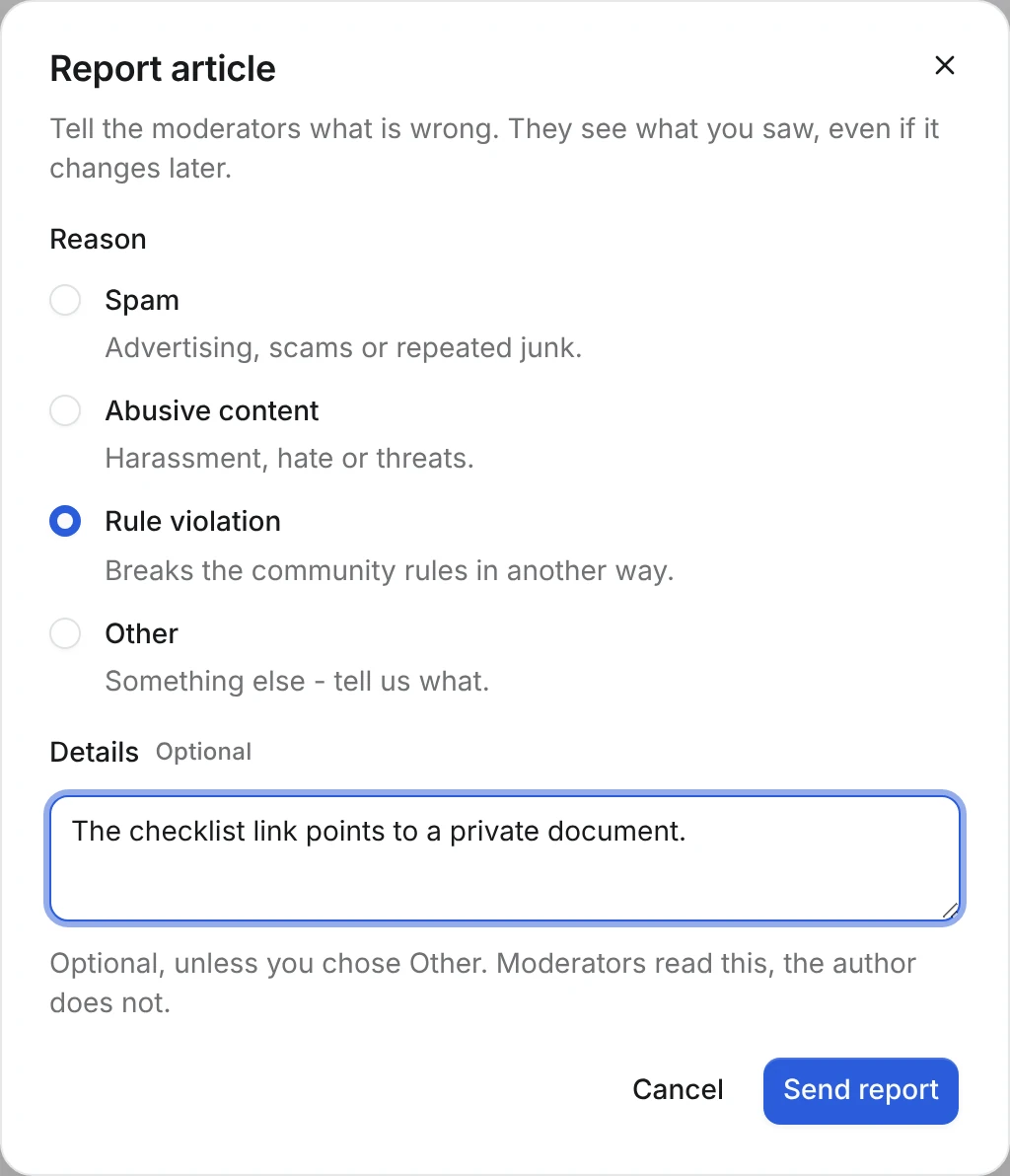
A toast says Report sent. Try sending it again and the toast tells you, politely, that you already did. A moderator with can_view_reports on the blog now sees the report in the ModCP.
What the server checks
- The reporter must be signed in. A guest gets
401. - The target must be readable by the reporter through the public API. Anything else is
404, the same answer as a typo. - Other needs at least 10 characters of details. Details are at most 2000 characters.
- One reporter can hold one open report per target. Other reporters get their own reports.
- A user can file at most 20 reports per hour, on top of the per-IP rate limiter every API route has.
Reports work for targets outside the Content Engine too. A plugin registers its own target with defineReportTarget. See the reference.